
Rion has been producing particle counters for the pharmaceutical and semiconductor industries as a partner in quality control and cleanliness management for over 50 years.
Rion was the first company to introduce particle counters to Japan, and since then, Rion's products are now used across the world.
Here we will introduce the history of Rion’s particle counters in conjunction with the history of the semiconductor industry.
Start of Import and Sales of Airborne Particle Counters
In December 1971, during a technical seminar and exhibition on pollution prevention sponsored by the U.S. Department of Commerce, a U.S. trading company visited Rion's booth, active in the field of pollution, and requested if we would be interested in selling airborne particle counters. Rion, recognizing the promising nature of the product crucial for the further development of the company in the environmental hygiene sector, decided to initiate the import and sales of airborne particle counters.
Commencement of In-House Particle Counter Development
In pursuit of more stable quality and enhanced in-house maintenance services, Rion embarked on the development of in-house particle counters.
Launch of Rion’s First In-House Airborne Particle Counter “KC-01”

Rion introduced its first particle counter, the “KC-01,” featuring a minimum detectable particle size of 0.3 μm. KC-01 received widespread acclaim for setting a top-tier performance at that time in despite of its compact size and affordable cost. Its popularity continued to grow, particularly in markets such as cleanroom cleanliness management for pharmaceutical companies.
LSI Integration Scale Reaches Approximately 100,000 Units
Around 1970, the integration scale of LSIs (Large Scale Integrated Circuits), which was approximately 1,000 units per substrate, exponentially increased. In about ten years, it expanded to a scale of around 100,000 units. The adoption of LSIs played a crucial role in advancing the performance of computers.
Rion Takes the First Step into the Semiconductor Market by Launching its “KC-14” Airborne Particle Counter

The first product introduced by Rion to enter the semiconductor market was the particle counter “KC-14.” Particle management in semiconductor manufacturing processes requires a minimum detectable particle size of 0.1 μm. Although Rion was behind the introduction of similar products by Western competitors, Rion developed the “KC-14,” utilizing a more advanced helium-neon gas laser instead of the conventional halogen lamp. This innovation achieved a minimum detectable particle size of 0.11 μm. Through this product, Rion's capabilities in development became widely recognized. During this time, Rion established optical system design technology using elliptical mirrors, laying the groundwork for essential technologies to catch up with leading Western companies steadily.
Launching Japan’s First Liquid-borne Particle Counter, the “KL-01”
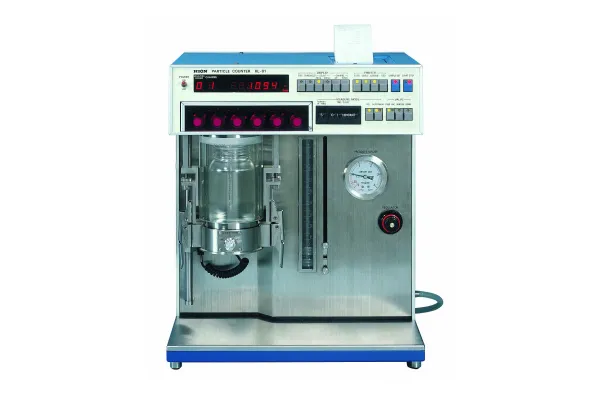
Responding to increased demand from the pharmaceutical field for devices to measure particles in liquids, Rion developed the first domestically produced liquid-borne particle counter, the “KL-01.” At that time, foreign-made liquid-borne particle counters were complex and expensive, with many parts componentized. The “KL-01” was an all-in-one device that could be easily transported, and its particle detection unit was replaceable. It was sold at less than half the price of foreign-made products. The KL-01 was used not only for pharmaceutical industries but also with hydrolytic fluid or fluorocarbon used as a cleaning solution for electronics parts back then. It established its position as an alternative management method to direct microscopy.
Launching the Liquid-borne Particle Counter “KL-21” with a Hydrofluoric Acid-Resistant Flow Cel

Chemicals used in semiconductor manufacturing processes can be strongly corrosive. One such chemical, hydrofluoric acid, posed a significant challenge as it would dissolve the flow cell part (made of quartz glass) within particle counters. Developing a liquid-borne particle counter capable of measuring hydrofluoric acid presented a major hurdle. Rion, in collaboration with a partner company, successfully developed the world's only* flow cell resistant to hydrofluoric acid. This cell was incorporated into the liquid-borne particle counter “KL-21,” which was then released. The KL-21 achieved the industry's smallest measurable particle size at that time, 0.3 μm. It dominated the Japanese semiconductor market and found widespread adoption across device manufacturers, chemical manufacturers, and material manufacturers.
*At the time of release
Mass Production of VLSI
The manufacturing of Very Large-Scale Integration (VLSI) circuits, with an element integration density exceeding 10 million, began in earnest. In the production of VLSI, high-purity technology became crucial to prevent dust generation inside equipment used in processes involving materials such as gas, water, chemicals, and in operations like thin film formation and microfabrication processing.
Release of Gas-borne Particle Counter “KC-90” Series

In the manufacturing of VLSI, essential materials often include gases with challenging properties such as strong toxicity, corrosiveness, and the tendency to ignite upon exposure to air. Addressing the high risk associated with these semiconductor material gases, Rion released the Gas-borne Particle Counter “KC-90” Series. The KC-90 Series is a system-based configuration that combines sensors and controllers. It can be integrated into electronic component manufacturing equipment to monitor particle conditions, contributing to improved yield and quality assurance on the manufacturing site.
Spread of PCs to Homes and Increased Demand for DRAM
With the release of Microsoft’s “Windows 95,” PCs went from being a specialized tool to a common one widely accessible for everyone. The improved UI, including connectivity with peripherals such as mice and printers, and the ability to connect to the internet led to a significant surge in the demand for DRAM.
Release of 0.1 μm Liquid-borne Particle Sensor “KS-16” for Inline Measurement
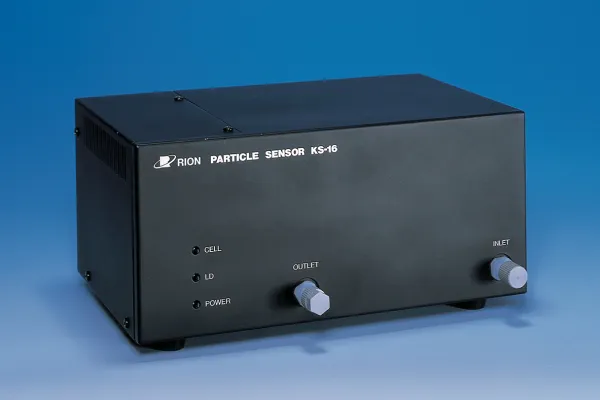
To continuously monitor the fluctuation of particle counts in solvents and ultra pure water within semiconductor manufacturing equipment, cleaning devices, and solvent supply systems, we released the compact liquid-borne particle sensor “KS-16,” which can be connected to supply lines and is capable of measuring particles as small as 0.1 μm, offering a more compact design compared to conventional instruments. The following year, we introduced the “KS-16F,” which also supports hydrofluoric acid.
Release of Particle Counter “KL-03” for Insoluble Particulate Matter Testing for Injections

For liquid pharmaceuticals directly administered to the human body, such as injectables and infusions, the size and quantity of particles they contain are regulated by the Japanese Pharmacopoeia and similar laws in various countries. In compliance with the testing method for insoluble microparticles in injectables outlined in the 13th revision of the Japanese Pharmacopoeia Supplement 1 published in 1996, Rion released the “KL-03,” a measurement system for insoluble microparticles in injectable solutions, designed to adhere to the method using a light-shielding type automatic particle measurement device.
Release of Rion’s First Airborne Particle Counter with Laser Pumped Solid-State Laser “KC-22A”

As the semiconductor industry advanced towards higher integration and miniaturization, particles affecting yield became increasingly smaller. Rion developed a laser pumped solid-state laser as the light source for particle detection. Addressing challenges associated with the previously used helium-neon laser source, Rion released its first product, the “KC-22A.” The following year, Rion introduced the “KC-22B,” ideal for dust emission testing in high-capacity HDDs. With the KC-22A, Rion achieved a minimum detectable particle size of 0.08 μm for the first time, enabling the detection of even smaller particles.
Release of Rion’s First High Flow Rate Airborne Particle Counter “KC-24” Capable of Measuring from 0.1 μm

With the widespread adoption of HDD recorders, portable music players, large-screen slim TVs, and other electronic devices, the electronics industry saw stricter standards for managing the size and concentration of particles in manufacturing environments that impact quality. In the ISO 14644-1 standard for cleanrooms Class 1, which is the highest cleanliness level, are required to have 10 or fewer 0.1 μm particles per cubic meter. Since particle counters cannot measure all the air in a room, in environments with almost no particles, more accurate measurements can be achieved by sampling as much air as possible. Rion’s “KC-24” is capable of reliably measuring 0.1 μm particles from 28.3 L/min of air, suitable for cleanroom management. It continues to be adopted by semiconductor device manufacturers and material companies for cleanroom control.
Widespread Use of Various Electronic Devices and Advanced Integration of Semiconductors
In the electronics industry, PCs and mobile phones became popular. In 2007, the first “iPhone” was launched in the United States by Apple Inc. As the improvement of fine processing technology led to increased high integration and miniaturization, there arose a demand for particle counters capable of more precise measurements, as particles affecting product yield became even smaller.
Release of Liquid-Borne Particle Controller “KE-40B” and Liquid-Borne Particle Sensor “KS-42” Series

Many of the currently deployed liquid-borne particle counters detect particles using particle sensors, with their operation control and measurement data display managed by a connected controller. In 2007, to enhance convenience compared to previous products, the controller “KE-40B” was launched, featuring a color LCD and a touch panel. It was complemented by the liquid-borne particle sensor series “KS-42,” which incorporated a multi-channel wave height analysis function. This combination allowed for the arbitrary setting of up to 10 stages of particle size classification. Since then, the system centered around KE-40B (and its successor model KE-40B1) has become the standard for Rion's liquid-borne particle counters.
Release of the World's First Liquid-Borne Particle Sensor “KS-41B” Capable of Measuring Particles in Photoresist Solutions from 0.1 μm

As part of the cleanliness management for photoresist and SOG solutions used in semiconductor manufacturing processes, Rion pioneered the development of the liquid-borne particle sensor “KS-41B.” This groundbreaking sensor is capable of measuring particles with a minimum detectable size of 0.1 μm. In the semiconductor process, where photoresist solutions significantly impact yield, Rion's particle counter remains the only product capable of measuring these solutions.
Developed the World’s First “Biological Particle Counter” that Instantaneously Distinguishes Whether Particles in Liquid are Biological or Non-Biological
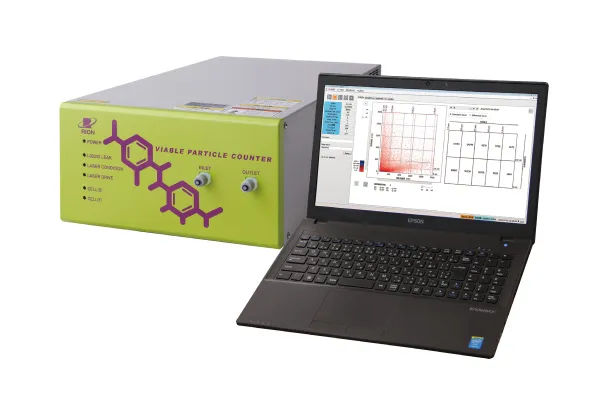
Utilizing its particle detection technology, Rion has developed the world's first “biological particle counter” capable of instantly distinguishing whether particles in a liquid are biological or non-biological. By detecting the light emitted by auto-fluorescent substances in biological cells using particle measurement technology, this counter provides real-time monitoring, replacing the conventional method of culturing bacteria for 3 to 5 days to confirm their presence. The biological particle counter enables real-time monitoring, significantly reducing the risk of bacteria in various fields that handle water, including the provision of drinking water and medical water.
Release of Liquid-Borne Particle Sensor “KS-19F” Capable of Detecting 30 nm Particles in Chemicals

With the advancement of semiconductor microfabrication technology, the demand for measuring even smaller particles in quality control for semiconductor factories and materials/chemical manufacturers was increasing in the cutting-edge semiconductor market. In response to the need to stably measure fine particles, Rion released the liquid-borne particle sensor “KS-19F,” an industry-first solution capable of detecting particles as small as 30 nm in chemicals. Rion's particle counters are widely used overseas, meeting the demand to accurately measure fine particles.
*At the time of release
Development and Release of Real-Time Measurement System “Picoplankton Counter” for Water Treatment Plants

Applying the technology of the biological particle counter, Rion has developed the “Picoplankton Counter,” which enables real-time measurement of the number of plant planktons. When plant plankton abnormally proliferates, it can cause serious malfunctions in the water purification process, leading to various issues such as the generation of abnormal odors and increased turbidity. Picoplankton Counter can help to control the injection of chemicals necessary for inhibiting plant plankton in the water purification process more effectively.
Release of “High-viscosity Measurement System” that Allows Measurement Without Diluting High-Viscosity Samples

In cutting-edge semiconductor manufacturing, high-viscosity solvents such as high-viscosity KrF, thick film resists, varnishes, and polyimides are commonly used. Conventional measurement systems for high-viscosity samples had limitations on the viscosity of measurable samples, often requiring dilution for measurement. In an industry-first initiative*, Rion released a “High-viscosity Measurement System” that allows measurement of original samples without dilution.
*As of September 2019, according to our company's research.
Release of Online Monitoring System “XL-M4B” for Pharmaceutical Water

In the quality control of purified water and water for injections in pharmaceutical factories, conventional inspections were primarily conducted using the culture method. However, there was a risk of delayed response in the event of contamination from microorganisms. Since the inclusion of “Rapid Microbiological Testing Methods” in the reference information of the Seventeenth Revision of the Japanese Pharmacopoeia in 2016, there has been increased attention towards rapid measurements. In response to this, Rion released the “XL-M4B,” a biological particle counter that enables early detection of microbial contamination through continuous monitoring.
Release of Liquid-Borne Particle Sensor “KS-20F” for Measuring 20 nm Particles in Chemicals

Responding to the increasing demand for measuring particles smaller than 30 nm in the quality control of cutting-edge semiconductor manufacturing processes, Rion introduced the “KS-20F.” This liquid-borne particle sensor is capable of measuring particles as small as 20 nm in chemicals. It has been widely adopted across the world.